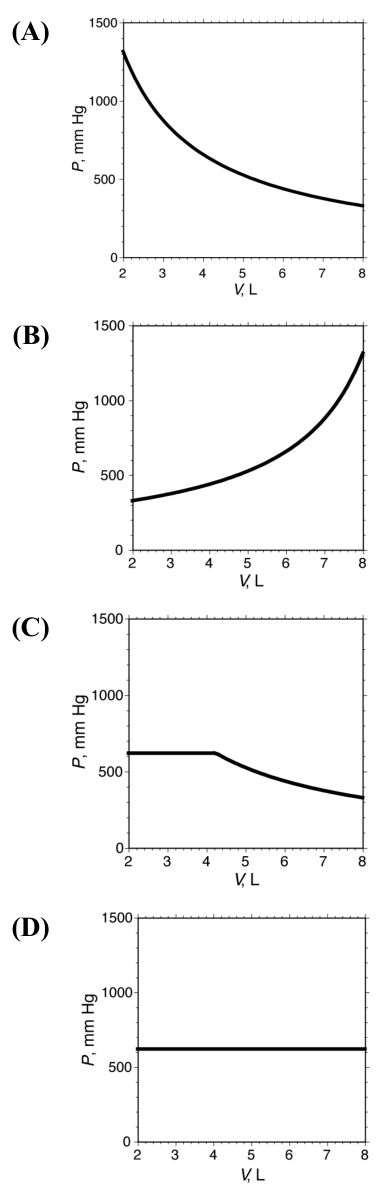
An adjustable-volume container holds 10.0 g pentane (M = 72.15, normal boiling point = 36.1 ºC). The pressure in the container is measured as a function of volume while maintaining the temperature at 30 ºC. Which graph shows the results of this experiment?
20% of national qualifiers got this right
Explanation
draftStep 1 – Amount of pentane. .
Step 2 – What happens at 30 °C, below the normal boiling point (36.1 °C)? At this temperature pentane cannot be a gas at high pressure — some of it will condense to liquid whenever the container is small enough. As long as both liquid and vapor are present, the pressure in the container is fixed at the equilibrium vapor pressure of pentane at 30 °C (roughly 600–620 mmHg, close to but a bit below 1 atm since 30 °C is a little below the boiling point). This gives a flat (constant-pressure) region at small volumes, where liquid is still present.
Step 3 – When all the liquid has evaporated. Once the volume is large enough that all 0.1386 mol of pentane exists as vapor, the system behaves as an ideal gas and further increases in cause to drop according to .
Step 4 – Check the numbers. If all the pentane were vapor:
- At — matches the low-pressure tail of the curve.
- At , the ideal-gas formula would predict , but this exceeds the vapor pressure of pentane at 30 °C, so instead the pentane simply condenses and the pressure stays pinned at the vapor pressure (~600–620 mmHg) rather than rising that high.
So the correct curve must start flat (constant = vapor pressure) at small , then bend downward and follow the ideal-gas curve once all the liquid has vaporized — this is exactly graph (C).
Assumes pentane behaves as an ideal gas at all volumes shown, ignoring that at small V and 30 °C (below the 36.1 °C boiling point) liquid must be present, which pins the pressure instead of letting it rise above the vapor pressure.
Reflects the correct trend of an ideal gas but with V and P mixed up in direction (pressure rising with volume), the opposite of Boyle's law behavior — an axis/trend misreading.
Correct: at small V, liquid and vapor coexist so P stays constant at the vapor pressure; once all liquid vaporizes, further volume increase makes P fall following .
Assumes the container always contains a two-phase liquid–vapor mixture over the entire volume range, so pressure never changes; ignores that the container is large enough at high V to vaporize all the liquid, after which pressure must decrease.
USNCO 2019 National Part I exam, question 16. © American Chemical Society; reproduced for non-commercial practice.