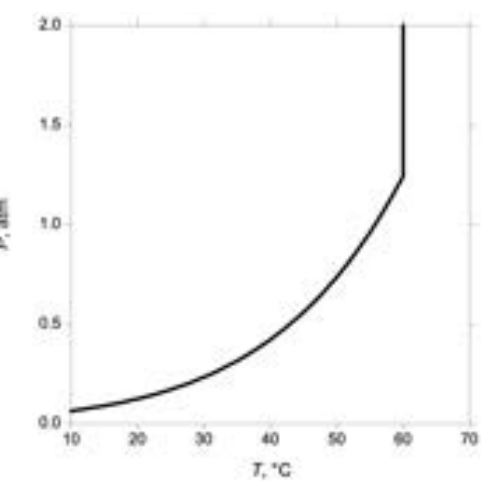
A sample of a pure substance is placed in a sealed, rigid container and the pressure is measured as a function of temperature. Which is the best explanation for the result shown?
5% of national qualifiers got this right
Explanation
draftIn a sealed rigid container, as long as two phases (liquid + vapor) coexist, the pressure follows the liquid's vapor-pressure curve — pressure depends only on temperature, not on the fixed volume or amount of each phase. This explains the smooth curved rise in from 10 °C to 60 °C.
At 60 °C, the curve suddenly kinks and shoots up steeply and linearly with . This behavior is characteristic of a single phase (here, all liquid) filling the container: once all the vapor condenses (or the last bit of liquid boils away... but here it's the liquid that fills the container), any further heating just compresses the liquid, which is nearly incompressible, so pressure rises very sharply for small changes in (large ).
So:
- Below 60 °C: liquid + vapor coexist, = vapor pressure curve.
- At/above 60 °C: only liquid present, and rises steeply because the liquid is nearly incompressible in the rigid container.
This matches option B.
Incorrect — this describes a solid–vapor sublimation curve turning into liquid–vapor at a melting point, but the curve shown is a smooth exponential vapor-pressure curve typical of liquid–vapor equilibrium, not solid–vapor equilibrium; there's no reason to invoke a solid phase here.
Correct — the curved region matches the liquid–vapor equilibrium (vapor pressure) curve, and the sharp upturn at 60 °C corresponds to the last vapor condensing so the container becomes filled entirely with nearly incompressible liquid, causing to rise steeply with .
Incorrect — this assumes the sharp rise at 60 °C indicates the critical point being reached, but a supercritical fluid would show smoothly continuous behavior without such an abrupt kink; the kink instead marks the disappearance of the vapor phase, not the disappearance of the liquid–vapor distinction.
Incorrect — this misreads the low-temperature region as vapor only, but a pure vapor obeying in a rigid container would give a smoothly increasing, nearly linear vs line, not the strongly curved exponential rise seen here, which is characteristic of vapor pressure equilibrium with a liquid phase present.
USNCO 2024 National Part I exam, question 17. © American Chemical Society; reproduced for non-commercial practice.